Last updated: October 27, 2026
In short: most menstrual cups are meant to stay in for up to 12 hours at a time, but the real limit depends on your flow, your cup’s capacity, and how full it gets before that mark.
If you want a simple rule for menstrual cup wear time, empty it sooner on heavy flow days and do not treat 12 hours as a goal. A cup that still has room at 8 hours is fine to leave longer; a cup that’s near full at 4 hours should come out earlier. The point is wear time, not endurance.
The short answer on menstrual cup wear time
A menstrual cup can usually stay in for 8 to 12 hours before it needs to be emptied. That is the practical answer most people need, and it is the one to use when planning a workday, a long commute, or overnight use.
The upper end matters because many cup manufacturers and menstrual-health groups give a 12-hour maximum for a full wear cycle. For guidance from manufacturers, see Lunette’s cup FAQ and DivaCup’s use instructions. That does not mean every cup should stay in for 12 hours no matter what. It means that if your flow is moderate and the cup is not filling quickly, 12 hours is generally the outer boundary for one wear period.
The lower end matters because heavy flow changes everything. If your cup fills in 3, 4, or 6 hours, waiting until the 12-hour mark can mean overflow, discomfort, or a mess when you finally reach a toilet. In that case, the safe answer is to empty it based on fullness, not the clock.
The useful rule is simple: plan for a maximum of 12 hours, but check sooner if your flow is heavy, your cramps are changing, or the cup usually fills before then. For the basics of cup use and first-time setup, the hub on menstrual cup basics and first-time setup is the right place to start.
What should actually decide when you empty it?
Your flow should decide first, then the clock, then comfort.
A menstrual cup is a container for menstrual fluid. If it has enough capacity for your flow, the timing is easy. If it does not, the timing gets shorter. That means the “right” schedule changes from day 1 to day 3 for many people, and it can change again on the first night of a heavier cycle.
Use these three signals together:
- Elapsed time: if 12 hours have passed, empty the cup even if you think it is not full.
- Flow volume: on heavy flow days, empty earlier, often every 4 to 8 hours depending on how fast the cup fills.
- Body cues: pressure, a feeling of fullness, or a sudden sense that something is off can mean the cup is filling up or shifting.
A cup does not need to be emptied on a fixed schedule like a medication. It needs to be emptied before it overfills. That is why “How long can you leave a menstrual cup in?” is really a question about wear time plus capacity, not a single number.
If you are new to cups, start conservatively for one cycle. Empty it at a bathroom break around 6 to 8 hours and note how full it is. If it is barely used, you may be able to stretch closer to 12 hours. If it is close to the rim, shorten the interval next time.
The point is to learn your own cycle, not to copy someone else’s timing. Heavy flow on day 2 is not the same as light flow on day 5, and that difference matters more than the brand name printed on the box.
How long can you leave a menstrual cup in overnight?
You can usually leave a menstrual cup in overnight for up to 12 hours, which is why many people use it for sleep.
Overnight use is one of the main reasons cups are popular. A 7- to 9-hour sleep window fits comfortably inside the usual maximum wear time, so you do not need to wake up just to empty it in the middle of the night. That is especially useful if getting to a toilet is inconvenient or if you do not want to manage pads or tampons while sleeping.
The catch is heavy flow. If your cup is often near full after 6 hours during the day, do not assume an 8-hour night will be fine. Sleep adds a complication: you are not checking the cup while it fills. On a heavy night, the cup may reach capacity before morning. If that happens, shorten the wear time by emptying right before bed, and again as soon as you wake up.
A practical overnight plan looks like this:
- Empty the cup before sleeping.
- Sleep your usual 6 to 9 hours.
- Empty it again in the morning.
- If the cup is very full in the morning, shorten the interval that night or during the next heavy day.
A menstrual cup is often a good fit for overnight use because it can hold menstrual fluid for longer than many pads or tampons can handle without changing. But “overnight” is not a free pass to ignore wear time. If you routinely sleep longer than 12 hours, or if your flow is heavy enough that the cup fills quickly, overnight use needs adjustment.
Because of that, the question stops being theoretical and becomes personal. Your night schedule, your flow, and your cup’s size all affect the answer.
What to do on heavy flow days
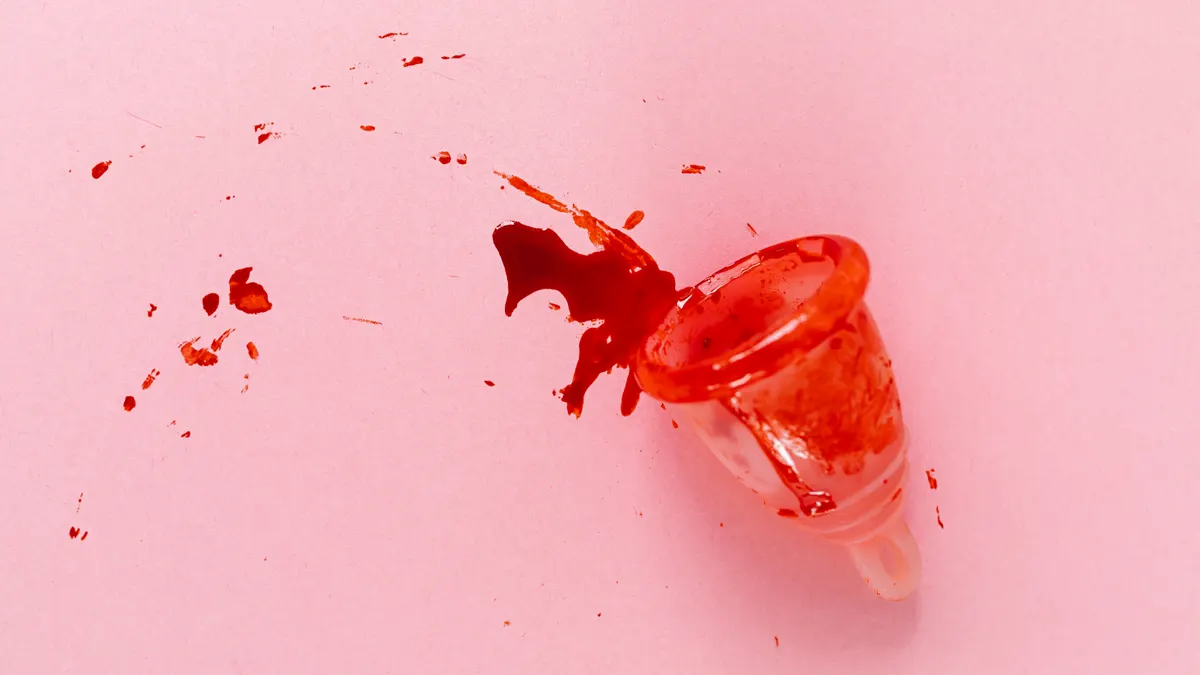
On heavy flow days, empty the cup more often than the 12-hour maximum, sometimes every 3 to 6 hours.
Heavy flow is the main reason people think a cup “doesn’t last long enough.” In reality, the cup may still be fine; it is just filling faster than on lighter days. The schedule needs to match the day, not the calendar.
A good rule on heavy flow days is to check the cup at the first likely bathroom break, then shorten the interval if needed. If you know your heaviest days are usually day 1 or day 2, plan around toilets, not convenience. A work shift, a train ride, or a long meeting can be fine if you empty before it starts. It is not fine if your cup is already close to full when you walk in.
Here is a simple way to handle a heavy day:
- Empty the cup first thing in the morning so you start with full capacity.
- Check it again after 3 to 4 hours if your flow is very heavy, especially on day 1 or day 2.
- If it is less than half full, you can usually wait longer before the next emptying.
- If it is close to full, shorten the next interval to 2 to 4 hours until the flow eases.
- Reset to a normal 8- to 12-hour pattern once the cup stops filling quickly.
The mistake is to treat heavy flow as a reason to “hold out” until the longest possible time. If you are unsure what is safe for your body, consult a clinician or follow the instructions from your cup maker, and check sources such as Mayo Clinic’s overview of menstrual cup use. The better move is to empty earlier and keep the cup working as a container, not a source of stress.
This is also the point where a cup’s capacity matters in a practical sense. Two cups can both be acceptable products and still behave differently on a heavy day. If you do not know your flow pattern yet, use one cycle to learn it before relying on the longest possible wear time.
Signs the cup has been in too long
The cup has been in too long if it has reached 12 hours, feels overly full, or starts to cause discomfort.
The 12-hour mark is the clearest boundary. If you are beyond it, empty the cup now. Do not try to rinse and reinsert later as if the clock did not count.
The more practical warning signs are simpler:
- A sense of pressure low in the pelvis
- A feeling that the cup is heavier than it was
- Fullness that makes sitting, walking, or bending more noticeable
- A cup that leaks after being fine for several hours, which can happen when it is full
- A strong need to reach a toilet soon because the cup is nearing capacity
These signs do not always mean something is wrong. Often, they just mean the cup needs emptying sooner next time. But they do mean you should not keep waiting just because the hours look reasonable on paper.
There is one honest limitation to say out loud: cup wear time is not a fixed medical timer for every body. If a cup stays comfortable for 10 hours but fills in 5 on another day, the shorter interval wins. That is not failure; it is flow variation.
If the cup ever feels painful, if you cannot remove it comfortably, or if you have unusual irritation, stop and get medical advice. A menstrual cup is not a substitute for care when something feels off.
Emptying frequency that actually works in real life
The best emptying schedule is one that matches your flow and gives you access to a toilet.
A cup is easiest to manage when your schedule lines up with normal bathroom stops: before leaving home, at lunch, after a long meeting, before bed, and when you wake up. You do not need a rigid routine if your flow is moderate; you need enough timing to avoid overfilling.
For example, if you leave home at 8 a.m. and return at 6 p.m., empty before you go and again when you get back. If you can access a toilet at work, a quick midday emptying turns a long day into an easy one. If not, shorten the wear period before leaving.
Think in ranges:
- Light flow: often 8 to 12 hours
- Moderate flow: often 6 to 8 hours
- Heavy flow: often 3 to 6 hours, sometimes sooner
Those are not rules carved in stone. They are planning ranges. The outer limit for one wear period is about 12 hours.
To make the schedule practical, tie it to a setting you already use. If you leave home at 8 a.m. and return at 6 p.m., empty before you go and again when you get back. If you can access a toilet at work, a quick midday emptying turns a long day into an easy one. If not, shorten the wear period before leaving.
The common mistake is waiting until the cup feels “obviously full.” By then, it may already be too late. A better method is to learn your own pattern over 2 or 3 cycles and use that as your baseline. The goal is not the longest possible wear time. The goal is predictable, low-stress wear time.
When not to push the wear limit
Do not push the wear limit if your flow is heavy, your day is unusually long, or you cannot get to a toilet when needed.
This is the section where the trade-off matters. A menstrual cup gives freedom, but only if you can empty it on time. If you are on a long travel day, stuck in a place without easy bathroom access, or dealing with your heaviest menstrual fluid output, the safest choice is to plan an earlier emptying or use a backup.
This is also where “12 hours” should not be read as a personal challenge. It is a maximum wear window, not a performance metric. If you are at 10 hours and the cup is already close to full, empty it. If you are at 8 hours on a very heavy day, empty it. If you do not know what your flow is doing, err on the shorter side.
A menstrual cup is a good tool for many people, but it is not the right tool for every moment. It is less useful if you cannot manage toilet access, if you need a backup because your flow is extremely heavy, or if you are still learning how your body responds to it.
For people who want a broader primer, the menstrual cup basics and first-time setup guide is the better companion piece. This page is for wear time and emptying, not for choosing a cup or learning insertion.
The practical rule to remember
Use the cup for up to 12 hours, but empty it earlier whenever your flow fills it sooner.
That is the cleanest answer. It respects the usual wear-time limit without pretending that everyone’s cycle behaves the same way. If you remember one thing, remember this: the clock matters, but capacity matters more. On a light day, 12 hours may be fine. On a heavy day, 4 hours may be the right call. The cup should serve your schedule, not the other way around.
Key takeaways
- Most menstrual cups are worn for 8 to 12 hours, with 12 hours as the outer limit for one wear period.
- Heavy flow shortens the schedule; many people need to empty sooner on day 1 or day 2.
- Overnight use is usually fine if the sleep window stays under 12 hours and the cup is not filling too quickly.
- The cup should be emptied based on fullness, pressure, and access to a toilet, not just the clock.
- If the cup is painful, hard to remove, or behaving unexpectedly, stop and get medical advice.
How long can a menstrual cup stay in?
A menstrual cup can usually stay in for up to 12 hours. That is the practical maximum wear time for one cycle of use, though many people need to empty it sooner on heavy flow days. If your cup fills faster than expected, empty it based on capacity rather than waiting for the full 12 hours.
How often should you empty a menstrual cup?
You should empty a menstrual cup based on flow, not a fixed schedule. Light flow may allow 8 to 12 hours, moderate flow often needs 6 to 8 hours, and heavy flow may need 3 to 6 hours. Check it sooner if you know your flow is strong or if you will not have easy access to toilets.
Can you sleep with a menstrual cup?
Yes, you can usually sleep with a menstrual cup in. An 8-hour sleep period fits within the common 12-hour wear window, which makes overnight use one of the cup’s main advantages. If your flow is heavy, empty it right before bed and again when you wake up so it does not overfill overnight.
Drafted with AI; not yet reviewed by a person.